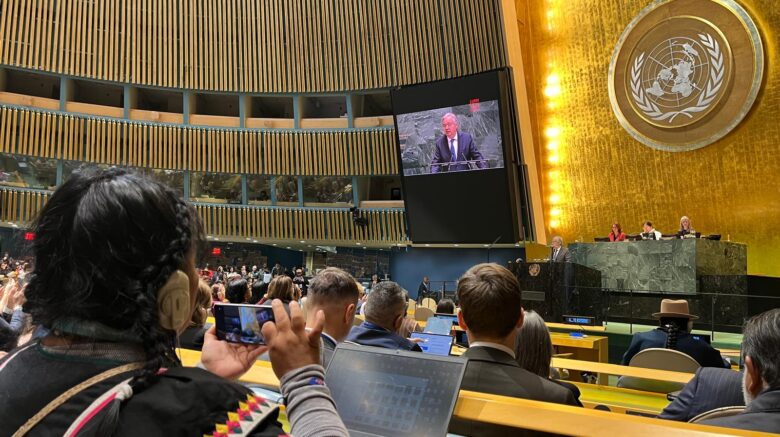
20 April – 1 May 2026
Agenda Item 3: Debate on “Ensuring the health of Indigenous Peoples, including in conflict contexts”
Intervention submitted by:
Olinda Castrellón Sanchez
Sub‑Coordinator of the Movement for the Defense of the Territories and Ecosystems of Bocas del Toro
With the support of:
The Center for International Human Rights
Pritzker School of Law, Northwestern University
21 April 2026
Madam Chair and honorable members of the panel,
My name is Olinda Castrellón Sanchez. I speak on behalf of my sisters and brothers of the Ngäbe people, who have inhabited for generations the region that is today known as the province of Bocas del Toro in Panama. Under Panamanian law, these lands should have been protected under the comarca system in order to recognize Indigenous territories in Panama. However, the Government never demarcated our lands, which left us exposed to constant threats of dispossession.
In accordance with the observations made by this Forum in its recent reports on Indigenous determinants of health, this dispossession of our ancestral lands reproduces centuries‑old patterns of colonial expansion, discrimination, and subjugation of our peoples and our territories. And we will not have health without our land.
While many Ngäbe people in Bocas del Toro continue to resist in order to remain on their lands, others have been forced to leave. I have witnessed firsthand how:
- The construction of the Inter‑American Highway that cuts through our lands has led to real estate speculation and the displacement of hundreds of people who previously did not need formal land ownership titles.
- The tourism, agricultural, and livestock industries have accelerated these land grabs, thereby undermining traditional ways of life.
- Energy projects, such as hydroelectric dams, have destroyed local landscapes, flooded sacred sites, and uprooted entire communities.
- Even so‑called “protected areas” for environmental conservation have prevented communities from accessing lands where they had sustainably farmed and hunted for generations.
Today, land tenure insecurity affects hundreds of Ngäbe families in Bocas del Toro. Among them is my family, which is largely composed of women heads of household. My family has suffered repeated acts of intimidation, harassment, and violence intended to force us to abandon the land on which we have lived for generations. In 2005, our homes were destroyed in an attempt to force us off our land to make way for cattle ranching. We resisted and rebuilt. But the threats have continued. Just last week, judicial authorities raided my family’s home in a new attempt to displace us. We are called intruders on our own land, and we never know what the next day will bring.
All of this has serious repercussions for our physical, mental, cultural, and community health. Displacement undermines our food sovereignty, as we are left without land to continue our traditional agricultural practices or to gather medicinal plants. Our mental health is affected by living in a situation of chronic insecurity. Our children live with the constant fear that one day, when they return from school, they may find their families harassed by the police or see their homes demolished. And the dispossession of our lands alters our worldview and prevents us from maintaining our traditional ways of life in harmony with Mother Earth.
Taking this situation into account, we respectfully request that the United Nations Permanent Forum on Indigenous Issues emphasize the fundamental importance of the demarcation and titling of Indigenous lands as an indispensable prior condition for guaranteeing our right to health.
Furthermore, in light of States’ international human rights obligations—including those deriving from Articles 1, 11, and 12 of the International Covenant on Economic, Social and Cultural Rights, as well as Article 2 of the International Convention on the Elimination of All Forms of Racial Discrimination—we urge the Forum to highlight in its final recommendations that:
United Nations Member States, including Panama, should:
- Adopt urgent and effective measures to put an end to the dispossession and displacement of Indigenous communities from our ancestral lands; and
- Guarantee Indigenous Peoples security of tenure over our lands, territories, and resources as a necessary step to ensure our physical, mental, and cultural health and well‑being.
Thank you.


 English
  Español