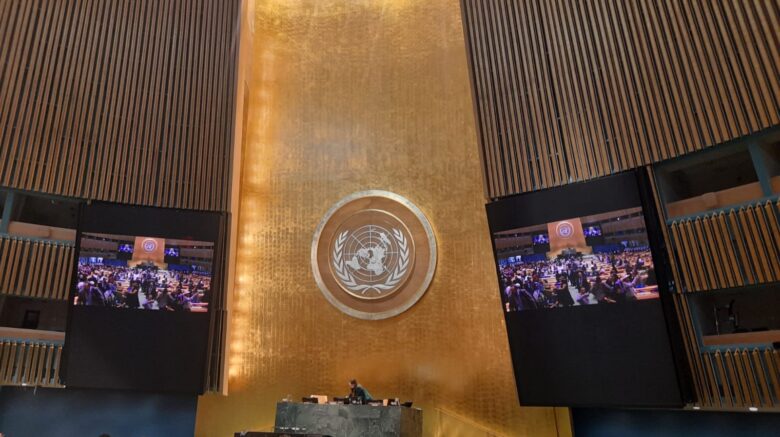
May 12, 2026 (Valle de Agua, Panama & Chicago, USA ) — On an advocacy mission to the United Nations in New York, the Movement for the Defense of Territories and Ecosystems of Bocas del Toro (MODETEAB) and the Center for International Human Rights (CIHR) at Northwestern University’s Pritzker Law School denounced land grabbing and the resulting health problems affecting Ngäbe indigenous communities in Panama. The organizations traveled together to the United Nations Permanent Forum on Indigenous Issues (“the Forum”), which concluded on May 1.
In a joint statement presented to the Forum, MODETEAB and CIHR highlighted the serious and lasting health damage caused by Panama’s refusal to demarcate Indigenous lands in the resource-rich province of Bocas del Toro, located in the northwest of the country. They called on Forum members to urge Panama to comply with its international human rights obligations, including protecting the right to health of Indigenous communities. This year, the Forum focused on “ensuring the health of Indigenous Peoples, including in the context of conflict.”
“Too often, Panama sides with economic interests that seek to seize Ngäbe lands, whether for tourism, industrial agriculture, or large-scale energy projects,” said Mr. Feliciano Santos Santos , Coordinator of MODETEAB. “When these economic activities invade our lands, they undermine our food sovereignty, our health, and our very way of life.”
“As the UN Forum works to promote the health and well-being of indigenous communities,” Mr. Santos added, “we call upon its members to urge States like Panama to guarantee security of land tenure, as an indispensable prerequisite for our physical, mental, and cultural health.”
In Bocas del Toro, approximately 150,000 Ngäbe people live in a state of legal insecurity, which has led to the forced eviction of dozens of Ngäbe communities from their homes, while those who remain face constant pressure to abandon their ancestral lands. Although Law 10 of 1997 required the Panamanian government to demarcate Ngäbe lands in Bocas del Toro as “annexed areas” to the Ngäbe-Buglé Comarca—an indigenous territory officially recognized by the government—the Panamanian government has never done so.
This situation severely affects the physical, mental, and social health of the Ngäbe communities . Many members of these communities say they can no longer gather medicinal plants or engage in the agricultural practices upon which their livelihood has depended for generations, as local authorities threaten them with fines and evictions . Others report that their children suffer from chronic anxiety, never knowing if, upon returning from school , they will find their homes demolished and their families displaced. The UN experts’ guidelines state that “the displacement of indigenous populations, against their will, from their territories and traditional environments, with the consequent loss by these populations of their food resources and the disruption of their symbiotic relationship with the land, has a detrimental effect on the health of these populations.”
Following her address at the United Nations Forum, Ms. Olinda Castrellón Sánchez, Deputy Coordinator of MODETEAB, stated, “The Ngäbe families suffer endless intimidation, threats, and violence to force us to abandon the land where we have lived for generations. We live in constant fear of having our lands taken from us, and we never know what the next day will bring.”
“To put an end to these violations of our human rights, the Panamanian authorities must recognize and protect our land rights once and for all,” added Ms. Castrellón Sánchez. “Only then will our communities be able to live healthy and peaceful lives again.”
In addition to engaging with the UN Permanent Forum on Indigenous Issues, MODETEAB and CIHR met with other UN officials and urged them to raise with the Government of Panama their concerns about patterns of land dispossession and its consequences for the health of Ngäbe communities. These UN officials included members of the UN Expert Mechanism on the Rights of Indigenous Peoples, as well as the UN Special Rapporteur on the Rights of Indigenous Peoples, who recently questioned the Panamanian government about the excessive use of force and other human rights violations allegedly committed against the Ngäbe people in Bocas del Toro province last year.
Since the fall of 2025, Northwestern students enrolled in human rights practicum courses have collaborated with MODETEAB to analyze international human rights standards that protect the right to health of Indigenous Peoples and to document the multiple ways in which land displacement affects the health and well-being of Ngäbe communities in Panama.
“Through our collaboration with MODETEAB, we have witnessed firsthand the direct health and well-being consequences suffered by Ngäbe families and communities facing displacement,” said Professor Sarah Dorman, who directs the Access to Health Project at the Center for International Human Rights. “ To address these health harms, Panama must take urgent steps, in accordance with its international human rights obligations, to end land grabbing in Bocas del Toro and to properly recognize and demarcate the lands of Ngäbe communities.”
The 25th session of the United Nations Permanent Forum on Indigenous Issues was held from 20 April to 1 May 2026 at the United Nations Headquarters in New York. The Forum has previously recognized that, for Indigenous Peoples, damage to land, ecosystems, and food systems constitutes direct harm to their health.


 Español
  English