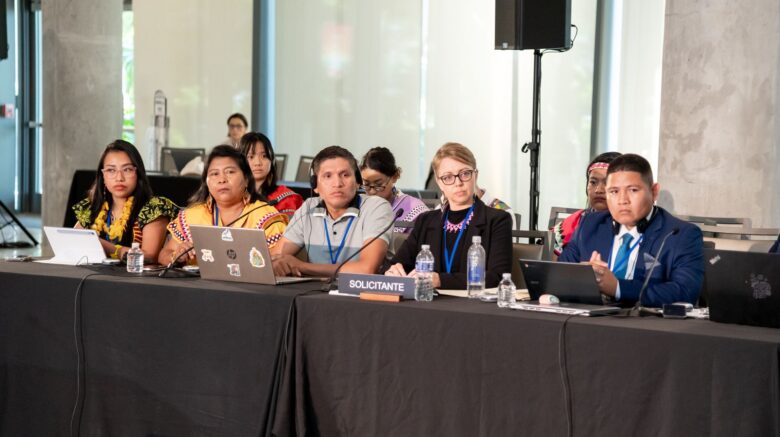
November 24, 2025, Bocas del Toro, Panama
On Wednesday , November 19, the Inter-American Commission on Human Rights (IACHR) received testimony from indigenous representatives regarding the repression carried out by Panamanian security forces in their territories and communities in 2025. This took place during a public hearing held as part of the IACHR’s 194th session last week in Miami, USA.
During this hearing, Indigenous representatives and members of civil society testified to the disproportionate and even lethal use of force against numerous Indigenous communities between May and July of this year in Darién, the Ngäbe-Buglé Comarca, and during the State of Emergency imposed in Bocas del Toro. They also denounced before the IACHR violations of freedom of expression, arbitrary detentions, inhuman treatment, and the suspension of fundamental rights and constitutional guarantees, such as habeas corpus , in Indigenous territories.
To place these violations in the broader context, Indigenous and civil society representatives highlighted how the Panamanian State has resorted to force and intimidation to impose its will on Indigenous territories, both within the established territories and in areas that still lack official recognition. They emphasized that the closure of civic space in Indigenous territories has reinforced historical processes of exclusion, discrimination, and violence against Indigenous populations, especially in the context of large-scale development projects and other economic investments that affect Indigenous lands and territories, leading to the displacement of entire communities.
After hearing the testimony, the representatives of the IACHR questioned the State of Panama about the legality, necessity and proportionality of the use of force against indigenous people and communities, as well as about the communications blackout that occurred in the province of Bocas del Toro, stating that it is not common for democratic states to implement general communications blackouts.
Additionally, the IACHR indicated its willingness to conduct a visit to Panama to analyze in greater detail the human rights situation of indigenous people in Panama. For its part, the Panamanian State confirmed that it will not oppose a visit by the IACHR.
During the hearing, Bernardino Morales, one of those affected by the Chan-75 hydroelectric project in the Ngäbe community of Guayabal, emphasized the progressive deterioration of civic space in Panama, stating:
“In previous hearings, the cruelty, discrimination, and use of force by state security forces against Ngäbe indigenous protesters opposing mining and hydroelectric projects in 2010 and 2012 were denounced. This resulted in injuries, maiming, and loss of life. […]
“The province of Bocas del Toro stood out as a major conflict hotspot due to its natural wealth and commercial interests. The lack of recognition of the collective ownership of indigenous communities—as in Valle de Agua with the case of the Castrellón family, who were victims of a completely rigged eviction process—continues to be part of the harassment by judicial and police authorities. […]
“Civic space has been closed to unimaginable levels since July 2024 with the entry of the current government, surpassing everything that happened in the past due to institutional violence, resumption of violent evictions—including in Valle de Agua in Bocas del Toro—with denial of judicial guarantees, criminalization, judicialization, imprisonment, persecution, intimidation of Embera , Wounaan, Naso and Ngäbe indigenous leaders, military occupation and the state of siege.”
For her part, Weny Bagama , a Ngäbe leader who was affected by the Barro Blanco hydroelectric project, declared before the Commission:
“ I am here to denounce the actions of the State, of the Government, in our territories, which are now officially designated as a Comarca. In this operation called Omega, the State violated the rights of women, children, and the elderly in their own homes. For example, the communities of Pueblo Nuevo, Ngäbe-Buglé Comarca; El Piro, Ngäbe-Buglé Comarca; and Cerro Venado, Ngäbe-Buglé Comarca. All of these communities were besieged day and night for many days. Tear gas was fired into their homes, targeting the children. Mothers had to flee to the mountains with their children to endure hunger because they were being persecuted in their own homes. […]
“All of this has been an attack on our people and our women, in our region, in our territory. And it hurts to mention it.”
After the hearing, Feliciano Santos, Coordinator of the Movement for the Defense of Territories and Ecosystems of Bocas del Toro (MODETEAB), one of the organizations that requested the hearing, stated:
“What we experienced in Bocas del Toro during Operation Omega was a brutal repression of the indigenous peoples by the Panamanian security forces. Far from establishing security, these forces created an atmosphere of violence, storming into communities, beating men, degrading women, and spraying pepper spray directly in the faces of residents.”
“Faced with the hostility of the Panamanian State, we have had to resort to the Inter-American Commission to claim our rights and demand justice, given that Panamanian institutions have ignored and violated our rights at all levels.
“As a result of this hearing, we hope that the Commission will take concrete actions to monitor the situation of indigenous peoples in Panama and to make an urgent visit to our communities, in order to listen to all those affected and directly assess these violent abuses.”
This hearing was at the request of: The Movement for the Defense of the Territories and Ecosystems of Bocas del Toro (MODETEAB), the Ngobe Center for Development and Technical Assistance (CEDETENG), the Local Congress of Piriati Embera Alto Bayano, the Alliance for Conservation and Development (ACD), and the Center for International Environmental Law (CIEL). At MODETEAB’s invitation, the Indigenous representatives were accompanied at the hearing by the Panama Law Firm, Cultural Survival , and the International Human Rights Clinic at Northwestern University. The recording of the hearing can be found on the IACHR website, here: https://www.oas.org/es/cidh/sesiones/audiencia.asp?Hearing=3857 .
The above comunicado in PDF format and Spanish can be found here:


 Español
  English